
You probably know your subject cold. You can explain it in a workshop, unpack it in a client meeting, and answer nuanced questions without notes. Then you sit down to shape that expertise into a book and hit a surprisingly hard question: what exactly is this book, who is it for, and why would someone choose it over the other options already on the shelf or in search results?
That's where many smart expert authors stall. The manuscript idea sounds solid in conversation, but the positioning is fuzzy. The result is a book that tries to do too much at once. It reads like part memoir, part manifesto, part business card, and part training manual. Readers feel the blur immediately, and so do publishers, podcast hosts, event organisers, and potential clients.
Non-fiction book positioning fixes that. It gives your book a centre of gravity. If you're a consultant, coach, executive, adviser, or specialist, it helps you build a book that works as a strategic business asset rather than a standalone product.
Table of Contents
- Study the shelf before you write the pitch
- Define one reader, not a crowd
- Separate reader appeal from business utility
- Use a simple positioning formula
- Weak positioning versus strong positioning
- What to check before you lock it in
- Turn strategy into proposal language
- Build discoverability into the package
- Make every touchpoint say the same thing
- Trying to serve everyone
- Writing an achievement book instead of a useful book
- Ignoring the competitive reality
What Is Book Positioning and Why It Matters for Experts
A consultant spends a year writing a book on leadership. The ideas are sound. The stories are credible. The manuscript still stalls because nobody can answer three simple questions fast enough. Who is it for, what result does it help create, and why this book over the others already in the category?
That is book positioning.
A positioned non-fiction book gives the market a clear reading of the project before anyone reads chapter one. It tells a reader, a podcast host, a publisher, a conference organiser, or a corporate buyer where the book fits and what job it does. For expert authors, that job is rarely limited to book sales. A well-positioned book can support consulting offers, keynote topics, workshop design, media commentary, and referral conversations.

I see the same mistake with experienced founders, advisers, and subject-matter experts. They assume authority will carry the book. It rarely does. Authority gets attention. Positioning gets decisions.
Readers make those decisions quickly. So do agents, booksellers, and event partners. If the promise is blurred, the book becomes harder to describe, harder to recommend, and harder to connect to a commercial outcome.
For experts in Australia, that matters because the book often sits inside a wider business model. The right positioning can help a leadership consultant win larger advisory work. It can help a coach move from one-to-one delivery into corporate programs. It can help a founder become the person journalists call when a topic hits the news cycle. If the book is positioned only as "useful for many people," it may still be readable, but it will do less work for the business behind it.
Positioning is a strategic choice
Positioning is the specific place your book aims to own in the mind of a defined reader and in the market around that reader. It is narrower than your expertise and more commercial than your topic. It shapes the title, subtitle, pitch, proposal, cover copy, sales conversations, and the opportunities the book can attract after publication.
The closest parallel is brand strategy. Authors who are familiar with understanding marketing brand strategy usually grasp this faster. A strong brand stands for something specific and creates a consistent expectation. A strong book does the same.
One practical test helps. If someone could swap your name and title onto ten competing business books without changing the promise, the positioning is still weak.
Why specificity wins
Broad positioning feels safer to the author because it seems to leave more doors open. In practice, it creates friction. Generic books are difficult to pitch, difficult to place, and easy to forget.
Specific books travel better.
Compare these two approaches. "A book for anyone who wants to lead better, grow faster, and create more impact" sounds ambitious, but it gives the market nothing concrete to hold onto. "A practical guide for first-time consultancy founders who need to turn specialist expertise into a clear offer, client pipeline, and repeatable delivery model" gives a buyer, reviewer, or podcast host a clean handle.
The second version excludes people. That is usually a strength, not a flaw. Clear exclusion sharpens relevance.
If you want your book to function as part of a larger authority strategy, the positioning work needs the same discipline you would apply to an offer, a category entry point, or a service-line decision. The book is a business asset. It should be built to attract the right reader and support the right next step. That broader strategic role is one reason I often point authors to frameworks like the 9 pillars of crafting a winning business book, because the strongest books are designed to carry both reader value and commercial value from the start.
Lay the Groundwork with Market and Audience Research
Good non-fiction book positioning starts outside your own head. Before you refine your angle, you need to see the shelf clearly. That means understanding both the books already competing for attention and the audience you want this book to move.
For expert authors, this step is where the project stops being an expression exercise and becomes a market-aware asset. The research isn't there to flatten your originality. It's there to stop you writing a book people can't place.
Study the shelf before you write the pitch
Start with comparable books. Not because you want to imitate them, but because you want to understand how the category talks.
Look at:
- Titles and subtitles: What promises are repeated? What words are overused? What outcomes seem to attract attention?
- Back cover copy and online descriptions: Do these books sell transformation, credibility, speed, simplicity, or a method?
- Category signals: Are they clearly practical, leadership-focused, personal development oriented, or operational?
- Author stance: Does the author present as teacher, contrarian, operator, researcher, or guide?
You're looking for patterns and absences. Sometimes the gap isn't a brand-new topic. It's a neglected audience, a clearer framework, a more practical tone, or a more business-ready application.
A useful exercise is to compare five to seven books side by side and write one sentence on each: “This book is really about…” That forces you to identify the actual market promise behind the cover language.
Define one reader, not a crowd
Many authors say their book is for “business owners”, “leaders”, or “professionals”. That's still too broad to position well.
Your ideal reader needs to be specific enough that you can predict what they're sceptical about, what language they use, and what they want fixed first. Often that reader is not just defined by role, but by context. A new consultant has different concerns from a corporate executive. A solo adviser buying business books reads differently from an HR team leader buying for internal development.
Don't ask only, “Who could read this?” Ask, “Who would feel this book was written for them within thirty seconds?”
One useful lens comes from the Australian market itself. Most advice on positioning assumes a broad reader segment, but doesn't deal well with books written by established experts who want a book to convert business opportunities, not just retail readers. That matters in Australia, where 2.6 million businesses are actively trading and 98% are classified as small businesses, as cited in this discussion of book positioning for a small-business-led market. A book for consultants, founders, and professional-service buyers needs a different promise from a consumer self-help title.
That's why audience research should include questions like these:
- What problem does this reader want solved now? Not someday. Not in theory.
- What kind of proof do they trust? Frameworks, examples, experience, systems, or implementation detail.
- What are they buying the book for? Personal reflection, team improvement, decision support, or help choosing an expert to hire.
If you need a wider planning structure around your book strategy, EAC has a practical article on the 9 pillars of crafting a winning business book that complements this positioning work.
Separate reader appeal from business utility
A common misstep for expert authors is to position their book as if the objective is to be read, when the actual goal is broader. They want the book to open doors, support consulting conversations, build authority with event organisers, and create trust before a sales call.
Those goals aren't wrong. They just change the positioning.
A reader-first consumer book often promises motivation, insight, or personal change. A business-facing expert book usually needs to promise utility, credibility, and implementation relevance. It has to make a time-poor buyer think, “This could help me solve something concrete” or “This author understands my operating reality.”
A short comparison helps:
| Book type | Core promise | Typical reader response |
|---|---|---|
| Consumer self-help | Feel better, think differently, live differently | “This speaks to me.” |
| Expert business book | Solve a specific professional problem with a credible method | “This could help my business or team.” |
That distinction should show up before you draft chapter one.
Develop Your Unique Angle and Core Idea
Most books start too wide. The author has a field of expertise, a body of work, a strong backstory, and a long list of things they could say. None of that is the angle yet.
The angle appears when you combine market insight with a distinct point of view and turn that into one clear proposition. That proposition becomes the book's organising idea. Without it, the manuscript drifts into expert sprawl.

Move from topic to argument
“Leadership” is not an angle. “Burnout” is not an angle. “Innovation” is not an angle. Those are topics.
A strong book angle makes an argument about the topic. It says something more precise, such as:
- leadership breaks down at a particular transition point
- burnout is often a systems problem, not only a resilience problem
- innovation fails when teams confuse ideation with commercial testing
That shift matters because readers don't buy broad subjects. They buy a lens, a method, a diagnosis, or a route through a problem.
For Australian non-fiction authors, a practical positioning sequence is to define a single big idea, turn expertise into an idea-centric promise, validate it against category demand, and publish proof-of-expertise content before launch. A common mistake is becoming author-centric, such as “my story”, rather than idea-centric, such as “my framework”, which makes it harder for buyers and media gatekeepers to tell who the book is for or why it's different, as discussed in this guide to professional groundwork for a successful nonfiction book.
Use the big idea test
A useful angle usually passes four tests.
- It's specific enough to explain in one sentence. If you need three paragraphs, the idea is still muddy.
- It changes how the reader sees a problem. A good angle reframes, not just repeats.
- It can carry a full manuscript. Some ideas are sharp but too thin. Others are broad enough but not distinct.
- It belongs to your real expertise. Not borrowed jargon. Not trend-chasing.
A memorable non-fiction book often becomes known for one phrase, one model, or one strong distinction. That's the practical shape of a big idea.
Many authors discover their best angle by asking a sharper question: what do I consistently say that makes the right people lean in? That's often more revealing than asking what topic you know most about.
If you're still shaping possibilities, this article on good book ideas for expert authors is useful for sorting promising concepts from loose interests.
Pressure-test the angle before you draft
Before you commit, test the angle in live settings. Use it in a LinkedIn post. Put it in a podcast pitch. Try it in a workshop description. See whether people understand it quickly and whether it attracts the right kind of questions.
Here are three signs the angle is working:
- People can repeat it back accurately.
- It triggers discussion about a defined problem.
- It naturally leads to your framework, process, or service area.
If the response is polite but vague, the angle probably lacks edge. If people respond with “That sounds interesting, but what does it mean?”, the wording needs tightening. If the wrong audience keeps leaning in, the promise is attracting curiosity rather than fit.
That testing stage saves a lot of rewriting later.
Craft a Powerful Positioning Statement
A positioning statement is where strategy gets forced into clarity. You can't hide inside broad concepts once you try to write one clean sentence. That's why I treat it as a working tool, not a branding exercise.
When a positioning statement is strong, it becomes the decision filter for the whole book. It tells you what belongs in the manuscript, what should be cut, how the subtitle should sound, and how to describe the project in a proposal or podcast introduction.
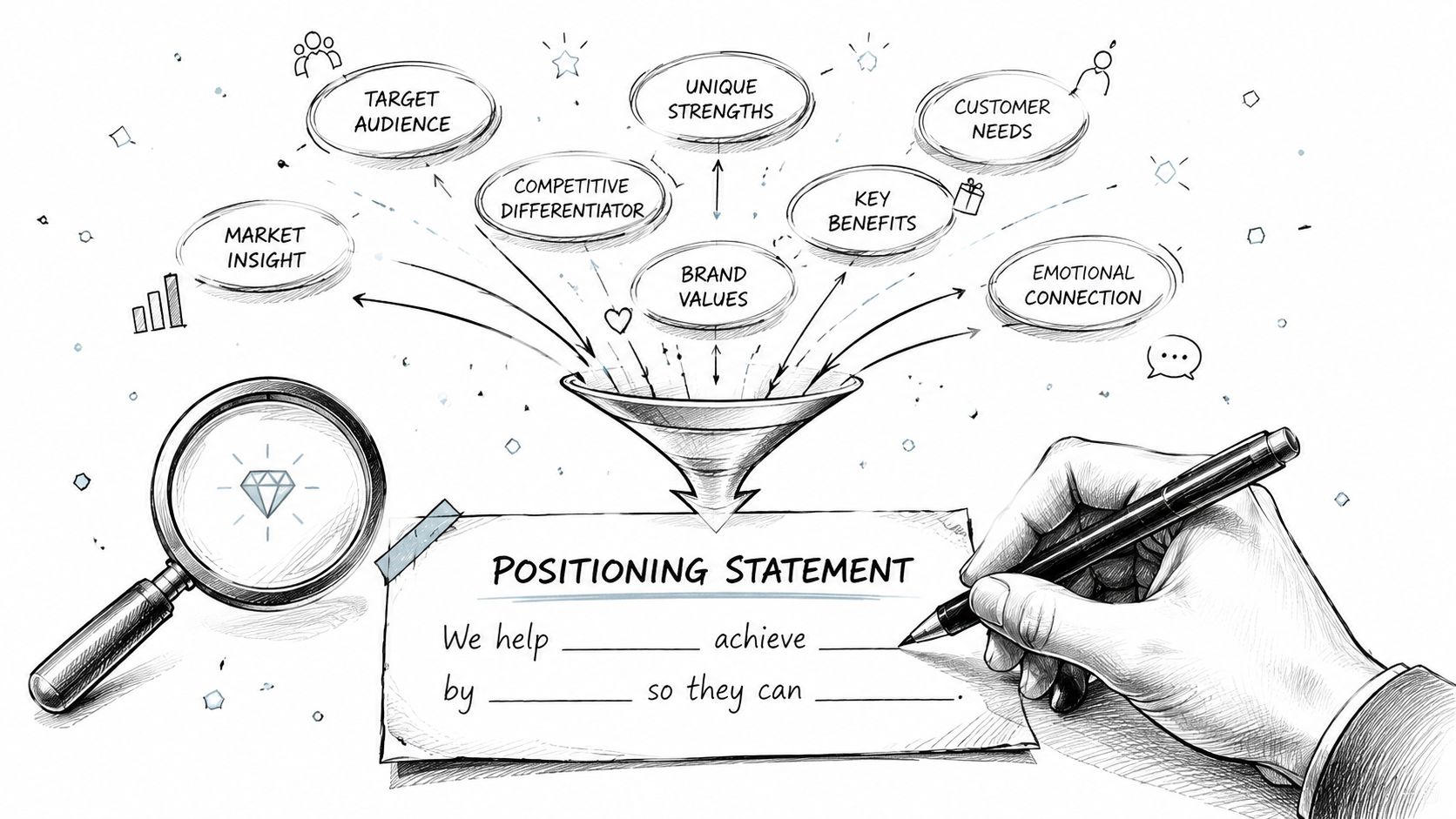
Use a simple positioning formula
You don't need a complicated framework. Start with this:
For [specific reader] who struggle with [specific problem], this book is a [clear category] that helps them [practical outcome] through [distinct method or perspective].
That's enough to expose vagueness fast.
A few examples:
- For first-time consultants who struggle to package their expertise, this book is a practical business guide that helps them create a clear offer, sales process, and delivery model through a simple advisory framework.
- For senior leaders managing team fatigue, this book is a workplace leadership guide that helps them redesign expectations, communication, and workload patterns through a systems-based approach to sustainable performance.
The formula works because it forces a choice. One reader. One pressing problem. One category. One meaningful result.
Weak positioning versus strong positioning
A weak statement usually sounds impressive but says very little.
| Version | Example |
|---|---|
| Weak | This book empowers leaders and professionals to unlock potential and thrive in change. |
| Strong | This book helps newly promoted leaders run productive teams without defaulting to overwork, unclear delegation, or constant firefighting. |
The weak version uses abstract language that could fit hundreds of books. The strong version identifies a transition point, a reader, and recognisable pain points.
Another example:
- Weak: An impactful book about communication in modern business.
- Strong: A practical guide for technical experts who need to explain complex ideas clearly to clients, executives, and non-specialist buyers.
After you draft your statement, read it aloud and ask two questions. Could a stranger understand it quickly? Could a bookseller, host, or client tell where it sits in the market?
A short explainer can help while you refine it:
What to check before you lock it in
Use this short checklist before you finalise the statement:
- Clarity: Would the right reader recognise themselves immediately?
- Usefulness: Does the promised outcome sound practical, not inflated?
- Difference: Is your method, lens, or framing visible?
- Fit: Does the statement match the kind of authority you want the book to build?
If the statement overpromises, narrow it. If it sounds bland, sharpen the problem. If it still reads like an author bio, move the focus back to the reader.
Integrate Positioning into Your Book Proposal and Marketing
A good positioning statement has one job after it's written. It needs to leave the planning document and show up everywhere the book is evaluated.
That starts with the proposal. Agents, publishers, and collaborators don't just assess whether the writing is strong. They look for signs that the book is easy to place, easy to describe, and easy to sell to a recognisable audience. Positioning gives them that confidence.

Turn strategy into proposal language
In a proposal, positioning should appear early and consistently. It belongs in the overview, the audience description, the comparison titles, the marketing section, and even the chapter summaries.
If your proposal says the book is for overwhelmed founders, but the chapter list reads like a broad leadership handbook, the positioning hasn't carried through. If the audience section names consultants, but the sample material sounds like mainstream self-help, the project feels unstable.
A stronger approach is to let the positioning statement govern each core proposal element:
- Overview: State the problem, audience, and promise in plain language.
- Audience section: Describe the primary reader with commercial realism.
- Competitive titles: Show similarity of category and difference of angle.
- Author platform: Present credibility that supports this exact promise, not every credential you have.
A simple planning tool helps here. The book canvas for expert authors is useful for aligning idea, audience, promise, and commercial intent before you polish proposal copy.
Build discoverability into the package
Positioning also shapes your title, subtitle, metadata, and sales language. In Australia, discoverability and positioning are tightly linked because more than 95% of search queries were conducted through Google in 2024, according to Google as cited in this discussion of search-driven discoverability for non-fiction books. That means subtitle keywords, search-friendly category terms, and a clearly defined reader problem are not optional.
The practical implication is straightforward. Your subtitle should help a search-driven reader identify relevance quickly. A clever title can work, but it usually needs a literal subtitle that clarifies audience and outcome.
Consider the difference:
- Clever but unclear: Signal
- Clearer package: Signal. A Practical Guide for Consultants Who Need a Sharper Point of View and Better Client Conversations
The second version does more work. It doesn't only sound more commercial. It is more searchable, easier to classify, and easier to pitch.
The subtitle is often where positioning becomes visible to the market.
The same principle applies to your book landing page, lead magnet, and event descriptions. If you need a strong model for structuring persuasive sales copy around a clear offer, this high-converting guide for product sales is useful because the conversion logic maps neatly to book pages and authority assets too.
Make every touchpoint say the same thing
Positioning becomes powerful when the manuscript, proposal, and marketing all sound like they belong to the same project.
That means your:
- Title and subtitle should reflect the promise.
- Back cover copy should identify the reader and problem fast.
- Podcast pitch should echo the same angle.
- LinkedIn content should publish proof of the same expertise.
- Website bio should support the same authority claim.
This is also the point where some authors benefit from structured support. One option is Expert Author Community, which provides a non-fiction book coaching program and community for experts working from idea and strategy through manuscript, publishing, and marketing. Whether you use a program, a coach, or your own process, the important thing is consistency.
A well-positioned book doesn't keep reinventing itself in different formats. It repeats the same strategic promise with discipline.
Common Positioning Pitfalls to Avoid
A consultant spends a year writing a book to win better clients. By launch week, the market still cannot tell whether it is a leadership book, a memoir, or a general business title. The writing may be strong. The positioning is doing no commercial work.
I see this often with expert authors. The problem is rarely a lack of knowledge. The problem is that the book is trying to be a business card, a personal story, a thought leadership manifesto, and a practical guide at the same time. In the Australian expert market, that confusion costs opportunities. A reader may hesitate to buy. A podcast host may struggle to place you. A potential client may not connect the book to the problem they would pay you to solve.
Trying to serve everyone
“This book is for anyone who wants…” usually signals weak positioning.
A better starting point is the reader with a live problem and a reason to act now. For a consultant, that might be founders preparing to scale. For an executive coach, it might be newly promoted leaders managing teams for the first time. For a B2B advisor, it might be CEOs in privately held Australian firms facing a specific growth constraint.
Breadth can come later. Clear positioning needs a centre.
Writing an achievement book instead of a useful book
Some experts produce what I call a resumé book. It proves they have done impressive work, advised important clients, and learned lessons the hard way. Those things matter, but they do not carry a book on their own.
Readers and buyers look for transfer. What will change after reading this book? What decision will become easier? What mistake will they avoid? If your positioning answers those questions, the book becomes more than a record of expertise. It becomes an asset that supports consulting offers, keynote topics, workshops, and high-trust conversations.
If your description leaves the reader clear on your credentials but unclear on the outcome, the positioning needs work.
One useful test is chapter by chapter. Ask whether each section mainly proves authority or helps the reader apply an idea. Strong non-fiction does both, but practical value needs to lead.
Ignoring the competitive reality
Some authors avoid comparison titles because they want to stay original. In practice, that usually produces generic language.
Good positioning comes from understanding the category and choosing your place in it. If five books already promise “better leadership,” a sharper book might focus on leading through rapid growth, post-merger integration, or frontline accountability. That is how an expert author becomes easier to refer, easier to remember, and easier to hire.
For Australian authors, this also matters at a business level. A book that sits clearly in a category is easier for event organisers, media producers, and referral partners to understand. Ambiguity slows down every one of those decisions.
A quick diagnostic helps catch common problems:
- Too broad: narrow the reader or the business problem.
- Too personal: turn life experience into a method, framework, or process.
- Too abstract: state the result in concrete terms.
- Too clever: use language the market already recognises.
- Too disconnected from the business: make sure the book points naturally to your services, speaking topics, or authority platform.
Positioning does not reduce your expertise. It gives that expertise a clear shape in the market.
If you're shaping a non-fiction book to build authority, attract the right opportunities, and support your business, Expert Author Community (EAC) offers a structured path from book idea and positioning through manuscript development, publishing, and marketing support for experts, consultants, coaches, and business leaders.

Thinking About Writing a Parable or Business Fable? Here’s What to Know First

Good Book Ideas: How Experts Turn Expertise Into Authority

.png)
28 New Business Books You Should Read in 2026