
Most advice about good book ideas is built for hobbyists, not experts. It tells you to brainstorm passions, follow inspiration, or write the book only you can write. That sounds nice. It's also how busy consultants, coaches, advisers, and operators end up with a manuscript that says something interesting but does nothing useful for their business.
If your book needs to build authority, open doors, support speaking, sharpen your offer, or attract the right clients, you can't treat the idea stage like a creative wandering exercise. You need to treat it like product strategy. A commercially viable expert book isn't discovered by accident. It's engineered through positioning, audience fit, and a promise you can deliver.
That doesn't make the work less creative. It makes it more honest. The best good book ideas for experts usually aren't the broadest or the cleverest. They're the ones that solve a defined problem for a defined reader in a way that reflects your real method, point of view, and lived experience.
Why Most Good Book Ideas Are a Trap for Experts
The biggest trap is thinking a good idea is one that feels exciting to write.
For experts, that's not enough. A book idea can be personally meaningful and still be commercially weak. It can be clever, heartfelt, and well-written, yet fail to attract the right reader because the concept is too broad, too memoir-like, or too detached from an urgent outcome.
That's why “write what fascinates you” is incomplete advice. Experts don't just need fascination. They need fit.
What usually fails
I see the same weak concepts repeatedly:
The big vague topic that could mean anything. Leadership. Resilience. Innovation. Culture.
The disguised memoir where professional lessons sit underneath a personal journey that readers didn't ask for.
The opinion dump where the author has strong views but no teachable framework.
The content scrapbook made from old talks, LinkedIn posts, and workshop notes with no unifying argument.
None of these are hopeless. They're just not ready.
Good book ideas for experts usually begin where a client says, “Can you help me do this?” not where the author says, “I've always wanted to express myself about that.”
What actually works
A strong expert-led nonfiction concept tends to do three things at once:
| What the idea does | Why it matters |
|---|---|
| Solves a clear problem | Readers know why they should care now |
| Codifies your method | The book becomes a business asset, not just content |
| Signals a position | People understand what you're known for |
That changes the brief entirely. You're not hunting for inspiration. You're selecting the sharpest vehicle for your expertise.
Practical rule: If your idea can't be explained as “This book helps this kind of person achieve this result,” it's still too fuzzy.
Experts often resist this because it feels reductive. It isn't. It's respectful. A serious reader wants to know what problem the book helps them think through, avoid, fix, or improve. If you can answer that cleanly, you're already ahead of most aspiring authors.
Uncover Your Core Message with Discovery Prompts
Most experts already have more than one possible book inside their work. The challenge isn't finding an idea from scratch. It's extracting the one that's most aligned with your strongest insight and the clearest reader need.
Start with the material that already exists in your practice. Your book shouldn't begin with “What could I write?” It should begin with “What do people already come to me for, and where do I have a repeatable way of helping?”
Start with the work people already trust you for
Open a blank document and answer these prompts without editing yourself.
What problem do clients keep bringing you? Not the broad category. The specific recurring mess.
What advice do you give so often that you're tired of repeating it? Repetition is a clue. It usually points to demand.
Where do people misunderstand your field? That's often where your sharpest positioning lives.
What result do your best clients want before they hire you? A good authority book often begins there.
Which part of your method do people struggle to apply on their own? That friction can become the spine of a book.
Now group your answers. You're looking for clusters, not isolated ideas. If several prompts point to the same issue, you may have the basis for a strong concept.
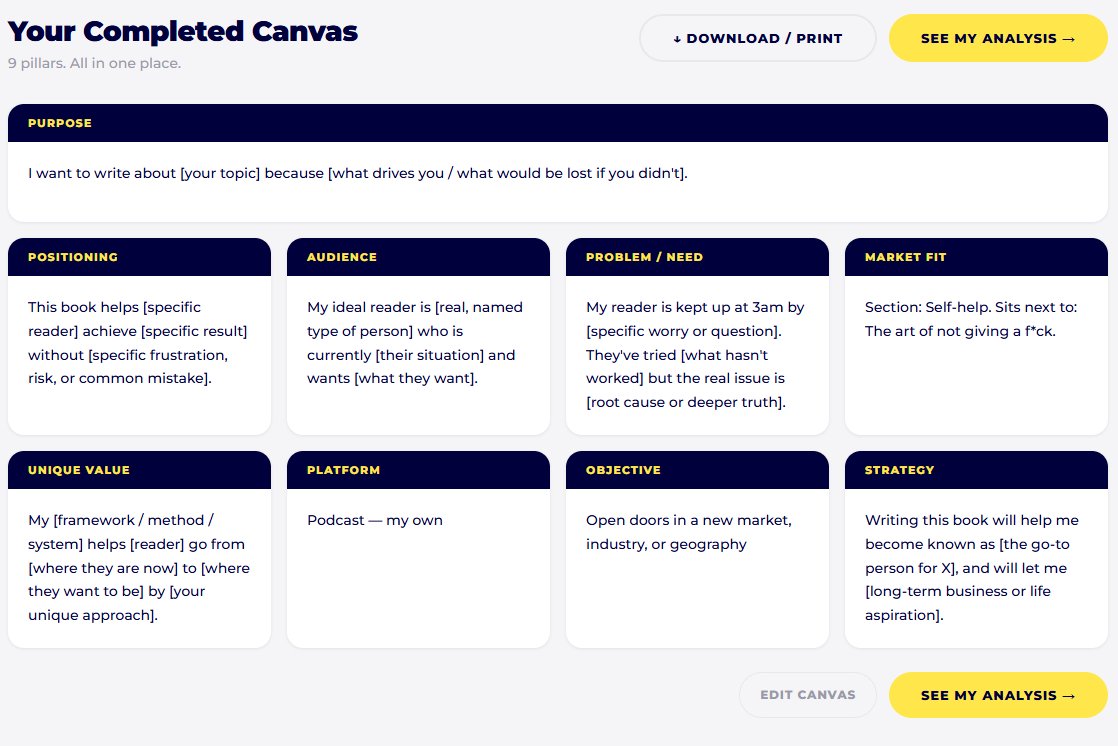
A practical tool can help here. The Book Screening Canvas from Expert Author Community is one option for mapping the reader, problem, promise, and positioning before you commit to drafting.
Mine tension, not biography
Experts often start with their own story because it's accessible. But story alone rarely creates one of the strongest good book ideas in business or professional nonfiction. What gives a book energy is tension.
Look for tensions like these:
What readers believe vs what works in reality
What organisations reward vs what creates long-term results
What your industry sells vs what clients really need
What's popular advice vs what happens in practice
Those tensions create argument. Argument creates structure.
Write down the myth you most want to correct. Then write the consequence of believing it. That consequence is often more commercially potent than the myth itself.
Try these deeper prompts:
What do smart people get wrong about your topic?
What costs them time, money, trust, momentum, or clarity when they get it wrong?
What do you do differently from others in your space?
What framework, sequence, or lens do you use that readers could apply?
What would a reader be able to do after finishing the book that they can't do now?
If your answers stay abstract, you don't yet have a book idea. You have a theme.
Three raw idea patterns that often produce viable concepts
Some of the most practical expert books begin in one of these shapes:
The diagnostic book
It helps readers spot a hidden problem, then offers a way to assess and address it.The decision book
It helps a professional audience make better calls under pressure, uncertainty, growth, or change.The implementation book
It takes a concept people already value and shows them how to execute it properly.
A final test helps. Read your rough idea aloud and finish this sentence: “This book is for people who are tired of...” If you can finish that sentence with clarity and conviction, you're getting closer to the core message that readers will recognise immediately.
Assess Your Idea's Audience and Market Fit
A promising idea requires a practical evaluation. This is the stage where enthusiasm meets evidence.
For Australian nonfiction writers, it's helpful to follow these steps before starting: target a specific Australian audience, ensure the topic addresses a common issue in business or careers, and check if the idea can lead to various commercial opportunities like keynotes or workshops. Aligning your idea with potential products is key, as readers and publishers prefer practical frameworks over broad personal-interest topics, according to Grammar Factory. The article suggests that focusing on a detailed, semi-fictional reader helps authors make better choices about their writing, which ties back to targeting a specific Australian audience.
A simple pass fail filter
Don't ask, “Do I like this idea?” Ask these instead.
| Check | Passing answer | Failing answer |
|---|---|---|
| Audience | “HR directors in mid-sized Australian firms managing hybrid teams” | “Anyone interested in leadership” |
| Problem | “They need to improve manager capability during growth and change” | “They want inspiration” |
| Commercial extension | “This can become talks, training, advisory work, and diagnostic tools” | “It's just a set of reflections” |
If an idea fails one of these checks, refine it before you write. Don't hope the manuscript will fix the concept. It won't.
How a vague idea becomes a viable one
Take a weak idea such as: The Future of Leadership.
It sounds substantial. It also sounds like dozens of other books.
Now narrow it.
Maybe the underlying issue is that newly promoted technical leaders don't know how to lead peers, delegate work, or communicate upward. That produces a stronger concept because the audience is identifiable, the problem is recurring, and the book can support workshops, talks, and leadership programs.
Compare the two:
Weak version
Broad audience. No urgent reader problem. Hard to position.Stronger version
A book for first-time leaders moving from specialist to manager inside technical or professional teams.
That's the difference between an idea that flatters the author and one that serves the market.
If the audience definition begins with “everyone”, “anyone”, or “all professionals”, stop. Narrowing isn't a compromise. It's how readers recognise themselves.
You don't need expensive research to test this. Use practical signals:
LinkedIn search patterns to see whether the audience title and problem language appear together.
Amazon and bookshop category scans to see how similar books position themselves.
Sales call notes and workshop questions to identify recurring phrases readers already use.
Conversations with existing clients, peers, or referral partners to check whether the problem feels immediate and worth solving.
A strong market-fit process also reveals what not to write. If your idea attracts polite interest but no urgency, that's a warning. If people say, “That's interesting,” but can't tell you who needs it or why now, keep refining.
Good book ideas survive contact with the market. Weak ones survive only in the author's head.
Frame Your Unique Promise and Position
Once the idea is viable, the next job is to sharpen the promise. At this point, many experts drift back into vagueness. They assume the topic itself will carry the book. It won't.
Readers don't buy a topic. They buy an outcome, a shift, or a clearer way through a problem.
Promise beats novelty
A lot of experts waste time trying to invent a totally original subject. That's rarely the right goal. In practical nonfiction, a strong promise matters more than a unique topic.
Leadership isn't unique. Productivity isn't unique. Client communication isn't unique. But a clear promise can still create a highly marketable position.
Try this sentence stem:
This book helps [specific reader] achieve [specific result] without [specific frustration, risk, or common mistake].
Examples:
This book helps first-time consultants turn expertise into a saleable point of view without sounding generic.
This book helps clinical leaders manage teams with more confidence without losing professional credibility.
This book helps founders document their operating principles without producing a book-length brand manifesto.
That's far more useful than saying, “My book is about leadership in modern times.”
A useful exercise is the Only statement:
This is the only book that...
For...
Because it combines...
You're not trying to prove there are no competing books. You're clarifying your angle.
For help shaping a commercially strong concept, title, and positioning, the thinking behind the 9 pillars of crafting a winning business book is a helpful reference point.
Pressure test the depth
A strong promise still has to survive the length of a full book. One of the best filters for that is whether the idea can be structured as narrative or problem-solution nonfiction with enough material to sustain chapter-level depth. A practical way to test this is to map one primary reader pain point, three to five supporting sub-arguments, and a chapter outline, with each chapter backed by interviews, case studies, or local data. If you can't do that, the concept may be too thin or too autobiographical, as explained in Jane Friedman's guidance on writing nonfiction when you're not an expert.
Use this quick pressure test:
Primary pain point
What exact struggle drives the reader to buy this book?Supporting arguments
What are the major reasons the problem exists, persists, or gets mishandled?Evidence sources
Where will your proof come from? Client patterns, interviews, professional experience, published material, local examples.Chapter progression
Does the argument build logically, or does it repeat itself in different words?
A book idea that works as a keynote, article, or podcast episode may still fail as a book. Books need progression, not just insight.
If the outline gets thin after chapter three, don't push ahead. Either narrow the promise further or broaden the evidence base. The right concept feels tighter as you test it, not flimsier.
Test Your Concept with a Proposal-First Approach
Most first-time authors do this backwards. They write a full manuscript, then try to work out what the book is about.
A better approach is to build a lean proposal first. Not because you need a perfect publishing document on day one, but because a proposal forces clarity early, when change is cheap.
Build the lean version first
Your draft proposal only needs a few components to become a useful testing tool:
The core summary
A short paragraph explaining the reader, the problem, your argument, and the transformation.The audience description
Not demographic fluff. A concrete description of who has this problem and why they'll care.A chapter list with one-line summaries
Enough to show the logic of the book.Your author case
Why you're credible to write it. That might come from direct experience, research access, professional practice, or a distinctive framework.Comparable titles
Not to prove imitation. To show where the book sits and how it differs.
This process exposes weak thinking fast. If you can't summarise the reader in plain language, the idea isn't ready. If the chapter list feels repetitive, the promise is too loose. If your author case relies only on enthusiasm, you need a stronger angle or more evidence.
One of the practical advantages is feedback. You can show a proposal draft to trusted peers, current clients, referral partners, and industry contacts. Ask narrow questions. Which part feels most urgent? What sounds vague? Would this solve a problem you see repeatedly? What would make the promise more compelling?
Test for reading and listening
Format fit now matters earlier than many authors realise. The Australian Publishers Association's 2024 reporting shows audiobooks remain one of the fastest-growing formats in the local market, which makes it worth asking whether your concept works for reading, listening, or both.
That affects the idea itself.
Books that often translate well into audio tend to have:
Clear chapter promises so a listener can follow the argument without visual cues
Repeatable frameworks that are easy to remember and explain aloud
Strong transitions and signposting so the structure feels coherent in the ear
Useful examples without overloading the listener with dense references
Books that struggle in audio often depend on charts, highly technical tables, or long stretches of abstract exposition.
Read your proposal summary aloud. If it sounds clunky, overloaded, or hard to follow, the problem may not be your speaking. It may be the concept.
A proposal-first approach de-risks the project. It helps you test the promise, structure, audience, and format before you commit months to writing chapters that may need major surgery later.
Your Next Steps to Pitching and Publishing
A validated idea gives you an advantage. It doesn't guarantee a deal or instant sales, but it puts you in a very different position from authors who start with a vague theme and hope the rest will sort itself out.
Your next job is straightforward. Finish the proposal. Tighten the positioning. Build enough visible platform activity that people can see you already own the conversation. Then decide which path suits the book and your business goals: agent, traditional publisher, hybrid route, or a more controlled independent pathway.
The opportunity is real for expert-led nonfiction in Australia. The ABS estimated Australia's resident population at 27.4 million in June 2025, which means even a niche expert book can still reach a substantial domestic audience, as cited in this note on the Australian market opportunity at the referenced reading-audience summary.
If you want to study how authors move from concept to launch planning, the book launch replay from Expert Author Community is one practical resource.
The important part is this. Don't wait until you feel inspired enough. Build an idea that can carry authority, sales conversations, speaking, and long-term positioning. Then write the book that idea deserves.
Frequently Asked Questions About Book Ideas
What if a similar book already exists
That usually means the category is real. The question isn't whether you're first. It's whether your angle, audience, and promise are sharper. Competing books can help you position your own more clearly.
How niche is too niche
If the audience is small but identifiable, has a real problem, and sees value in solving it, the niche may be exactly right. Expert books often work best when they're narrow enough to feel personally relevant and broad enough to support related offers, referrals, or rights opportunities.
Do I need a big social media following before I start
No. Platform helps, but it doesn't replace concept quality. A weak idea with a large following is still a weak idea. Start with the problem you solve, the readers you can already reach through your work, and the conversations you're already having in professional settings.
If you're turning expertise into a nonfiction book and want structure around the idea, proposal, and publishing path, Expert Author Community (EAC) offers a program and network for experts developing authority-building books with coaching, feedback, and a clear process.

Thinking About Writing a Parable or Business Fable? Here’s What to Know First

.png)
28 New Business Books You Should Read in 2026
The Work That Transforms You (Not Just Your Book)